
Francesca Gualteri reported about her library in a pharmaceutical company’s use of Elsevier’s ‘Mendeley’ to manage the internal literature repository. Interestingly, she mentioned problems with the importing, especially of Elsevier publications. Others in the audience confirmed these issues. I suppose quite a few of the participants at the conference are going to ask the Elsevier reps at their stall about this issue…
Tag: EAHIL 2014
Library blogging: what’s it actually good for?
Tuulevi Ovaska is a subject librarian from the University of Eastern Finland, with additional commitments at a hospital. In her talk at the 2014 EAHIL conference she reported on her experience in running a library blog that aimed to assist users with everyday search queries which tended to be about PICO, the ‘deep web’, and database searching. From the start Tuulevi added a list of answers to her users most frequently asked questions, but even so her (Finnish language!) blog attracted over 3’000 views within its trial period of around a year – part of which came from Sweden and the US.
What’s the meaning of library blogging? Tuulevi is certain her blog complements the library’s website, especially with news and marketing (in conjunction with social media), but also responding to real-life user enquiries.
Journal Apps
Guus van den Brekel presented an excellent comparison of four journal apps which the university of Groningen evaluated as a way to help academics keep up to date with their literature. How do your users want to read journals? Only in response to a concrete query, doing a database search? Or do they also browse tables of content? And how often do they do the latter – do they rather use RSS feeds from selected journals, or do they browse their favourite journals on a Friday afternoon?
All four apps come from fairly small, innovative companies, not from the big library software providers or publishers. They are:


The app that scored highest in the Groningen evaluation against a set of criteria and attracted a substantial amount of additional usage of the journals, was Browzine. I was glad to hear of this outcome: at Bern university we are currently trialling Browzine, too!
“Open” and the Library
Maria Cassella in her keynote speech at the EAHIL 2014 conference reports that “Open” – i.e. Open Access, Open Data, Open Educational Resources, Open Peer Review, MOOCs (Massive Open Online Courses) – has triggered a centrifugal trend away from the traditional channels of scholarly communication, including the library. This new trend contravenes the previous centripetal tendency of consolidation of all information related services in the library. As academics increasingly are in a position to produce and store data themselves – research data and publications, educational content; using repositories, cloud services and the like -, they use these new channels rather than the library. This could, ultimately, lead to the fragmentation of knowledge.
Librarians, so Maria, need to form partnerships to counter this dangerous trend: with faculty, students, IT. And they should develop new skills and professional roles, such as (as defined by the ALA as ‘core competencies in librarianship’ in 2009):
- data librarian
- digital cudrator/data curator
- scholarly communication librarian
- project manager
- ontologies specialist
- intellectual property rights specialist
- bibliometrics specialist
- knowledge facilitator
- educator
In the discussion, a colleague saw the risk that the wide range of highly specialised tasks could lead to specialisation and fragmentation of the profession of librarians. She was certainly right in the sense that none of us will be able to cover the full range of both our traditional and our new roles as a single person: we will need to split our tasks between several people with different focus. At the same time, as our roles rapidly change and evolve, we will have to keep up with these developments.
Here it is: the EAHIL 2014 conference in Rome!
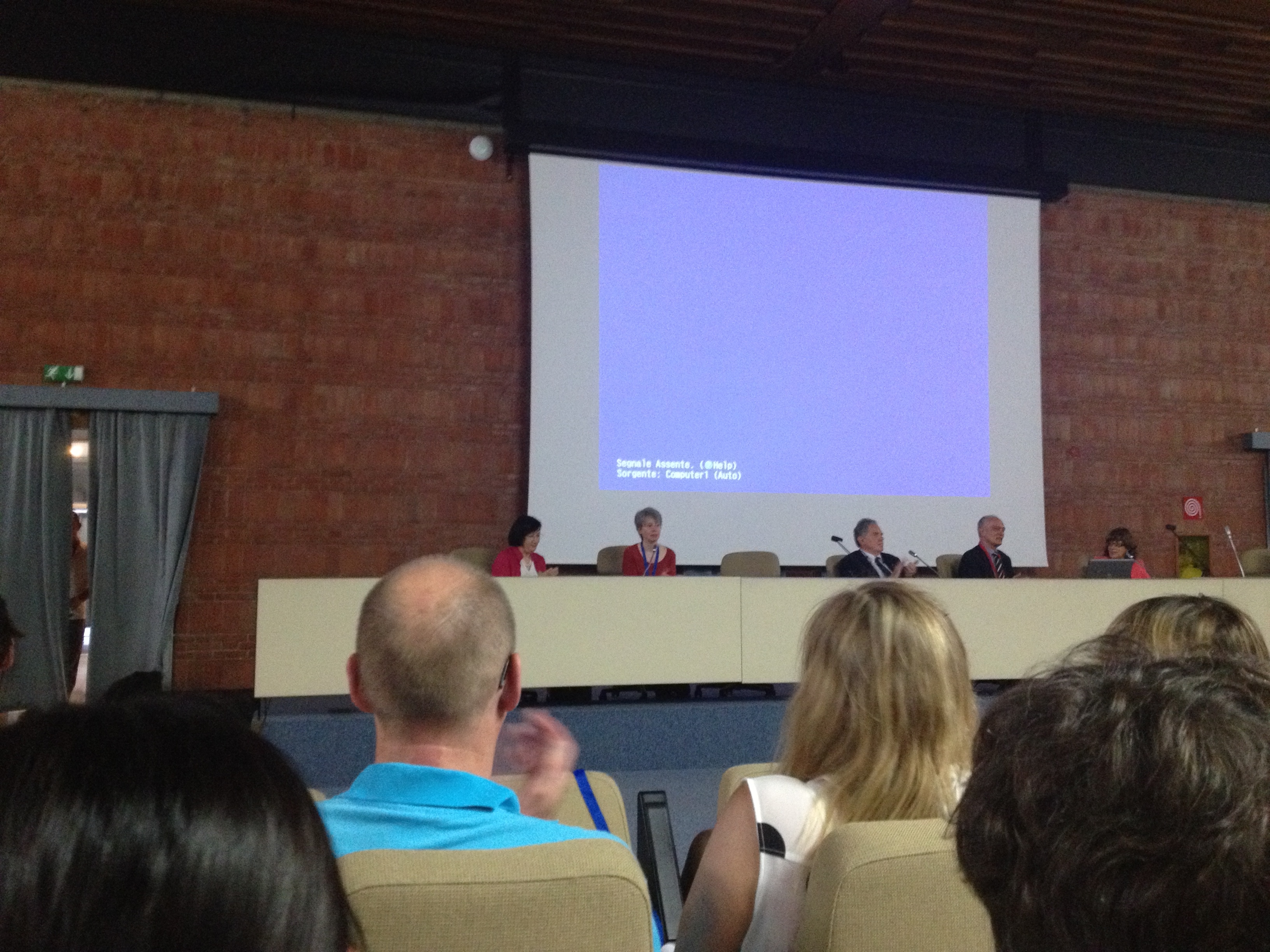
At last, I’m sitting in the lecture theatre of the Biblioteca Nazionale Centrale in Rome in the opening ceremony of EAHIL 2014. Browsing some of the posters as they were being put up in the foyer already brought me some new insights that I’ll have to build into my own work from now on. I really look forward to the all the things I’ll learn in the next three days!
 Gerhard Bissels's Weblog