
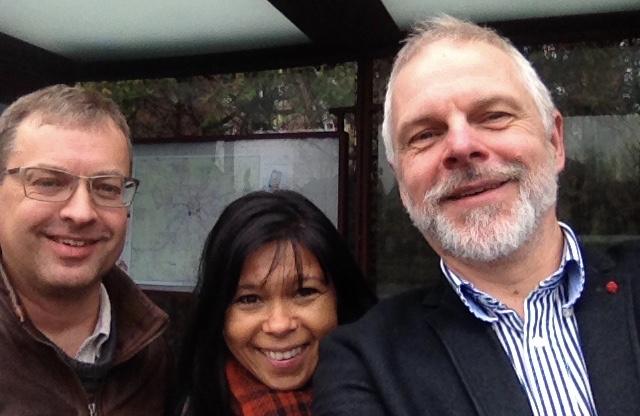
Fränzi and I visited two medical libraries this week, both well respected amongst medical librarian colleagues, but each with its very own preferences and focus.
The library of the AMC (Academisch Medisch Centrum) in Amsterdam has to focus on resources for research, as its director, Dr. Lieuwe Kool, explained: funding does not allow licensing e-textbooks, nor the purchase of multiple print copies. On the plus side, the AMC library’s team of four information specialists offer an extensive programme of training courses and one-on-one support, especially for advanced publications like systematic reviews.
The Münster Zweigbibliothek Medizin – voted Germany’s best special library by users – supports medical education better than probably any other medical library in Europe, with a substantial collection of multiple copies, e-books, apps, and even hundreds of borrowable iPads with the learning materials preinstalled. With the ‘Easyphysikum‘ project – all resources for the 1. Staatsexamen accessible on an iPad, Dr. Oliver Obst, the librarian, consolidated Münster’s role as innovative leader in medical education resources. Database training and enquiry services are available, too – and the building is comfortable, spacious, modern and well-lit.
It will be a long way until we here in Bern can compete against libraries like these…





 Gerhard Bissels's Weblog