Bye-bye Britain: How will ‘Brexit’ affect Medical Librarianship?

The national extremists have won the battle. The UK is going to leave the EU. Labour laws, environmental standards, human rights will all be weakened. ‘Now the Tories are going to bring back slavery’, I said to a Welsh colleague. ‘No, serfdom’, she replied. I feel sorry for my friends and colleagues in the UK. And for myself and my wife as we watch our British pension plans and our house in London losing value.

But how is ‘Brexit’ going to affect our profession?

The UK has, so far, been one of the nations that set standards in medical librarianship. In future I’m afraid that all kinds of academic and professional exchange and joint activities will become more difficult. Switzerland, too, was penalised by the EU for that ‘mass immigration’ referendum in 2014 by being kicked out of Erasmus. But at least Switzerland has made an effort to replicate Erasmus using national funding. Access to EU research schemes is a big issue for a society built on knowledge and skills. And it is hard to imagine any UK government would show commitment comparable to that of Switzerland in this field.

Given the enormous contribution UK colleagues have made to medical librarianship over a long period of time, we medical librarians need to discuss how we can help them maintain their current standards. As a professional body, EAHIL must keep an eye on the development, and we will act in solidarity – just as we did with our motion against the threatened closure of ZB Med in Germany at the Seville conference.
Parliament Hill Café beats ZB Med

On March 18th the news broke that the Senate of the Leibniz-Gemeinschaft had recommended to end funding ZB Med, Germany’s national library for Medicine and the second largest medical collection in the world.

Just a few days before North Londoners heard that the City of London Corporation (which owns Hampstead Heath) had decided to end the 33-year lease of the Parliament Hill Café to the d’Auria family, and hand the café over to the Benugo chain.

Three weeks later, 5,500 academics have signed a change.org petition to keep ZB Med, but the future of this important institution is still unclear. Meanwhile, over 23’000 supporters signed a petition against the City of London Corporation’s decision; Benugo – faced with such stiff opposition – subsequently withdrew its bid for the lease of the café.

ZB Med may simply be in the wrong business to attract a more substantial level of support from its customers.

The National License for the Cochrane Library is here!

Screen Shot 2016-01-01 at 18.54.58

From today, the whole of Switzerland has access to the Cochrane Library, thanks to the efforts of and funding by the Swiss Academy of Medical Sciences. Under the aegis of the academy, funding from existing academic and hospital licences were pooled and the total topped up by the SAMS to allow the whole nation access. In the course of the next months, the SAMS will, jointly with medical and cantonal libraries and professional bodies, make healthcare professsionals throughout Switzerland aware of this license and introduce potential users to it in workshops and through other channels.

So far healthcare professionals in countries with a national health service, such as the UK and the Scandinavian countries, have benefitted from library services provided for them by their employer while in all-private systems, such as in Switzerland and Germany, doctors outside of university hospitals are left to their own means – they have access to those few journals they have personal subscriptions for. And I haven’t even mentioned the rich libraries professional bodies offer their members in addition to the NHS resources: the BMA, the RSM and all the royal colleges run extensive library services with a print collection in London or Edinburgh, remotely accessible e-resources, and support through experienced librarians. Evidence Based Medicine can only be practiced where there is access to the evidence, alongside the professional support with information retrieval.

The SAMS has made a first step – and a bold one. We Swiss medical librarians will do our utmost to make it a success. Let’s hope more e-resource licenses will join the Cochrane access in the future!

IMG_1480

Up north

Fränzi and I visited two medical libraries this week, both well respected amongst medical librarian colleagues, but each with its very own preferences and focus.

The library of the AMC (Academisch Medisch Centrum) in Amsterdam has to focus on resources for research, as its director, Dr. Lieuwe Kool, explained: funding does not allow licensing e-textbooks, nor the purchase of multiple print copies. On the plus side, the AMC library’s team of four information specialists offer an extensive programme of training courses and one-on-one support, especially for advanced publications like systematic reviews.

IMG_1447

The Münster Zweigbibliothek Medizin – voted Germany’s best special library by users – supports medical education better than probably any other medical library in Europe, with a substantial collection of multiple copies, e-books, apps, and even hundreds of borrowable iPads with the learning materials preinstalled. With the ‘Easyphysikum‘ project – all resources for the 1. Staatsexamen accessible on an iPad, Dr. Oliver Obst, the librarian, consolidated Münster’s role as innovative leader in medical education resources. Database training and enquiry services are available, too – and the building is comfortable, spacious, modern and well-lit.

It will be a long way until we here in Bern can compete against libraries like these…

Library blogging: what’s it actually good for?

Tuulevi Ovaska is a subject librarian from the University of Eastern Finland, with additional commitments at a hospital. In her talk at the 2014 EAHIL conference she reported on her experience in running a library blog that aimed to assist users with everyday search queries which tended to be about PICO, the ‘deep web’, and database searching. From the start Tuulevi added a list of answers to her users most frequently asked questions, but even so her (Finnish language!) blog attracted over 3’000 views within its trial period of around a year – part of which came from Sweden and the US.

What’s the meaning of library blogging? Tuulevi is certain her blog complements the library’s website, especially with news and marketing (in conjunction with social media), but also responding to real-life user enquiries.

“Open” and the Library

Maria Cassella in her keynote speech at the EAHIL 2014 conference reports that “Open” – i.e. Open Access, Open Data, Open Educational Resources, Open Peer Review, MOOCs (Massive Open Online Courses) – has triggered a centrifugal trend away from the traditional channels of scholarly communication, including the library. This new trend contravenes the previous centripetal tendency of consolidation of all information related services in the library. As academics increasingly are in a position to produce and store data themselves – research data and publications, educational content; using repositories, cloud services and the like -, they use these new channels rather than the library. This could, ultimately, lead to the fragmentation of knowledge.

Librarians, so Maria, need to form partnerships to counter this dangerous trend: with faculty, students, IT. And they should develop new skills and professional roles, such as (as defined by the ALA as ‘core competencies in librarianship’ in 2009):

  • data librarian
  • digital cudrator/data curator
  • scholarly communication librarian
  • project manager
  • ontologies specialist
  • intellectual property rights specialist
  • bibliometrics specialist
  • knowledge facilitator
  • educator

In the discussion, a colleague saw the risk that the wide range of highly specialised tasks could lead to specialisation and fragmentation of the profession of librarians. She was certainly right in the sense that none of us will be able to cover the full range of both our traditional and our new roles as a single person: we will need to split our tasks between several people with different focus. At the same time, as our roles rapidly change and evolve, we will have to keep up with these developments.

Here it is: the EAHIL 2014 conference in Rome!

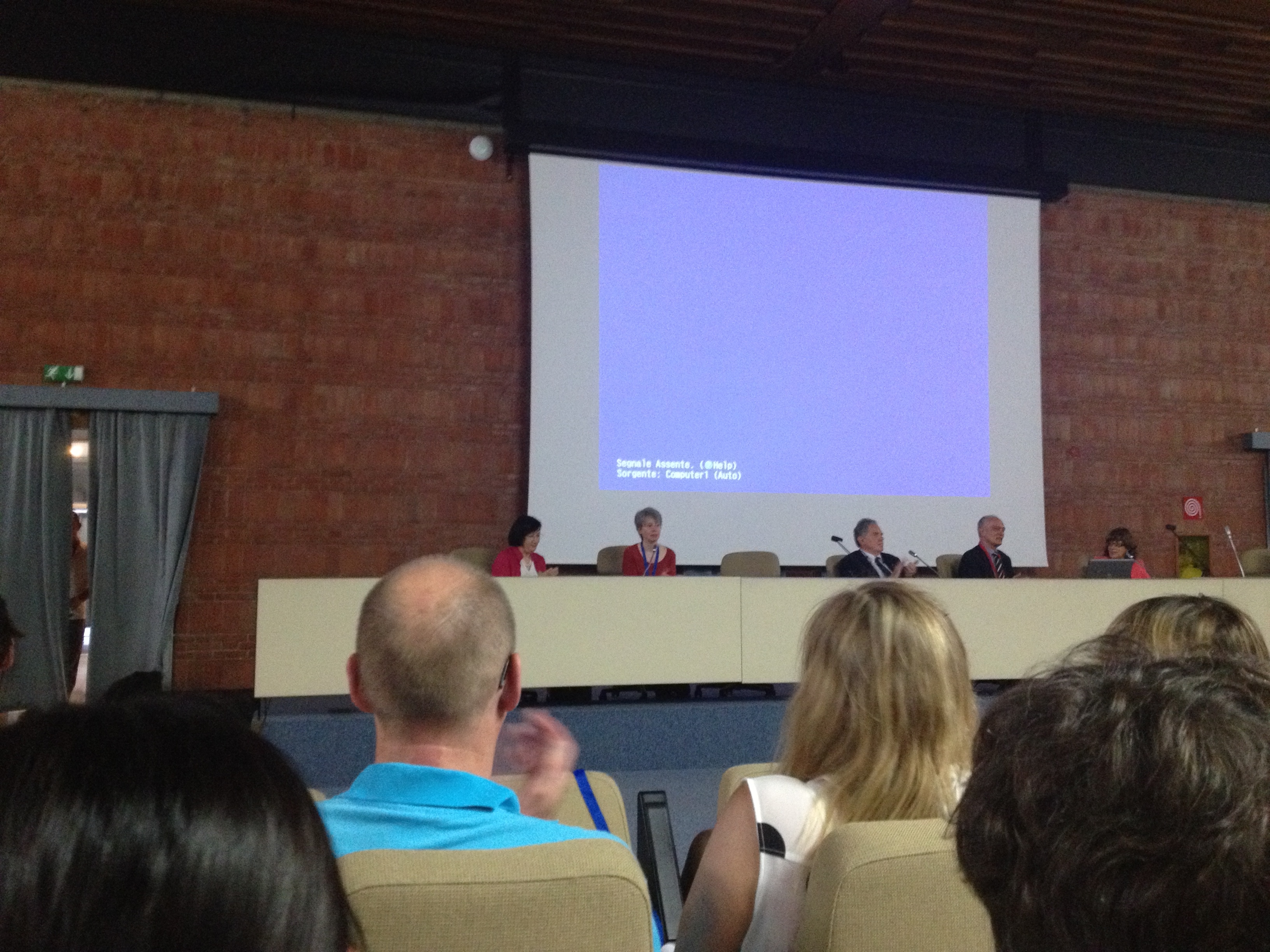
Opening ceremony  of the EAHIL 2014 conference at the Bibliotheca Nazionale Centrale, Rome
Opening ceremony

At last, I’m sitting in the lecture theatre of the Biblioteca Nazionale Centrale in Rome in the opening ceremony of EAHIL 2014. Browsing some of the posters as they were being put up in the foyer already brought me some new insights that I’ll have to build into my own work from now on. I really look forward to the all the things I’ll learn in the next three days!

Bern blogs!

It’s hard to keep abreast of developments in library services for the sciences and medicine. There are all the big developments of scholarship – from e-resources to research data to Open Access -, and there are also the local needs to take into account, too: curricula, projects, resources… A good chat with a colleague is often enlightening; there’s no need to keep re-inventing the wheel. So we thought we’d start a little blog through which we’ll communicate little bits of our experience to our professional colleagues. Just short reports from conferences and guest lectures, or notes about things we have tried ourselves. And, of course, we’d like to invite colleagues to complement our findings with theirs in a blog comment. Please feel free to contact us if you’d like to contribute a posting to our blog!