The National License for the Cochrane Library is here!

Screen Shot 2016-01-01 at 18.54.58

From today, the whole of Switzerland has access to the Cochrane Library, thanks to the efforts of and funding by the Swiss Academy of Medical Sciences. Under the aegis of the academy, funding from existing academic and hospital licences were pooled and the total topped up by the SAMS to allow the whole nation access. In the course of the next months, the SAMS will, jointly with medical and cantonal libraries and professional bodies, make healthcare professsionals throughout Switzerland aware of this license and introduce potential users to it in workshops and through other channels.

So far healthcare professionals in countries with a national health service, such as the UK and the Scandinavian countries, have benefitted from library services provided for them by their employer while in all-private systems, such as in Switzerland and Germany, doctors outside of university hospitals are left to their own means – they have access to those few journals they have personal subscriptions for. And I haven’t even mentioned the rich libraries professional bodies offer their members in addition to the NHS resources: the BMA, the RSM and all the royal colleges run extensive library services with a print collection in London or Edinburgh, remotely accessible e-resources, and support through experienced librarians. Evidence Based Medicine can only be practiced where there is access to the evidence, alongside the professional support with information retrieval.

The SAMS has made a first step – and a bold one. We Swiss medical librarians will do our utmost to make it a success. Let’s hope more e-resource licenses will join the Cochrane access in the future!
IMG_1480

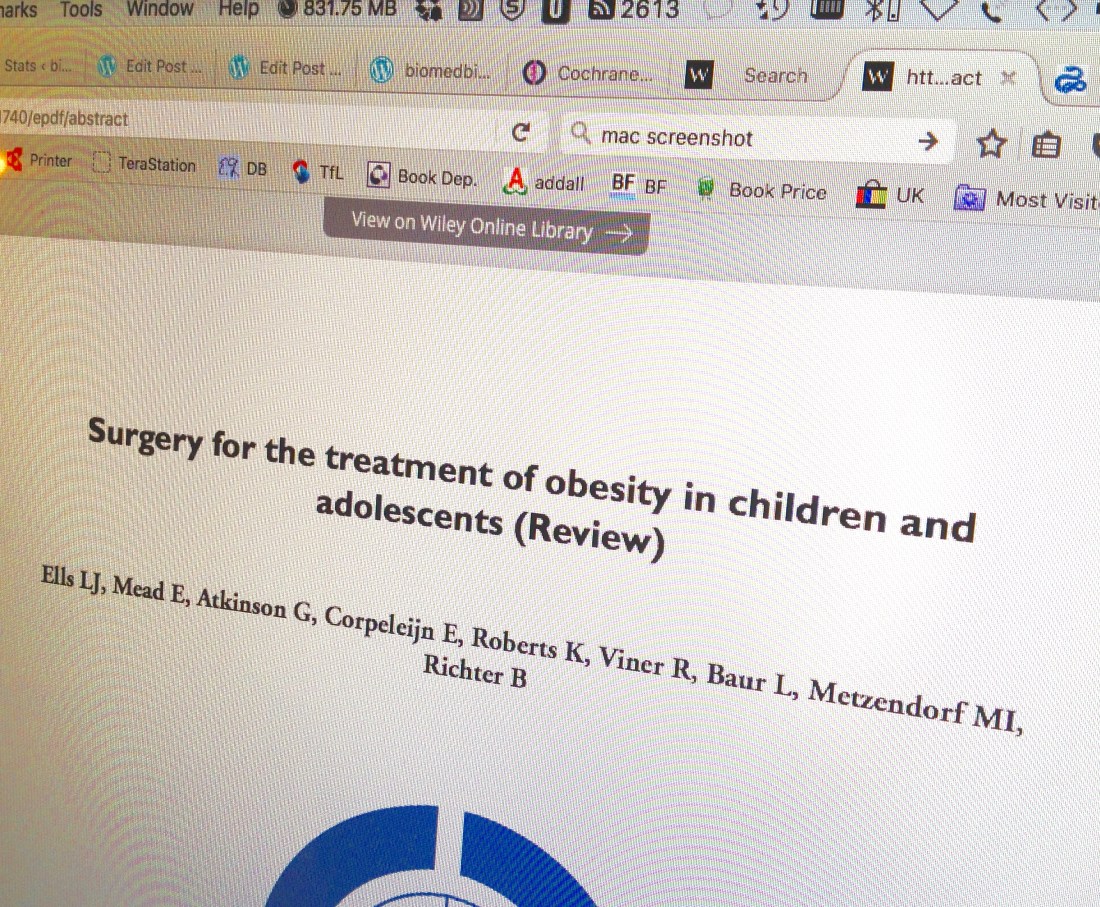
How To Do a Systematic Review 

This is a question medical librarians are often asked by prospective authors of systematic reviews. Books on the topic are usually weak on the librariany bits – the chapter on literature searching tends to consist of a descriptive list of databases, combined with the advice to ‘ask a medical librarian’… Fortunately, some colleagues have written useful guidance on the whole process. Here is a selection of some really outstanding library websites on literature searching for systematic reviews:

Each of these sites contains a wealth of references to both further reading and training courses. Of course, the range of training materials provided by the Cochrane Collaboration should not be forgotten either.

Librarian in the Cloud

IMG_1467
View of the cloud from mount Weissenstein © Gerhard Bissels 2016

So many of our services these days are ‘cloud based’. Ever wondered what it feels to be cloud-based? Well, I know, because I’m a librarian, and I live in Solothurn, a small town in Switzerland which hides under a thick cloud (locally referred to as ‘Näbu’, i.e. ‘Nebel’) for about two thirds of the year – see picture.

‘Cloud-based computing’ has become a buzzword amongst system vendors, and it seems to make some colleagues shudder with awe. But it really is just a rather nebulous way of trying to stir up a hype for externally hosted LMS and other big systems which end users then often access via their web browser rather than a client. Open Source systems such as Koha have worked in this way for a decade and a half – long before their commercial competitors came up with their foggy idea of ‘The Cloud’ as another marketing gimmick.

Solutions, solutions, solutions

Have you read Proquest’s press release about its merger with Exlibris? What struck me is the language: within that couple of paragraphs they managed to use the word ‘solutions’ eleven (11!) times, and there is no shortage of other buzzwords (‘innovation’, ‘innovative’, ‘integration’). Doesn’t such overuse of phrases make you rather suspicious? The Aleph users amongst us will be wondering how a product that hasn’t changed much in nearly twenty years, can be called ‘innovative’…

Up north

Fränzi and I visited two medical libraries this week, both well respected amongst medical librarian colleagues, but each with its very own preferences and focus.

The library of the AMC (Academisch Medisch Centrum) in Amsterdam has to focus on resources for research, as its director, Dr. Lieuwe Kool, explained: funding does not allow licensing e-textbooks, nor the purchase of multiple print copies. On the plus side, the AMC library’s team of four information specialists offer an extensive programme of training courses and one-on-one support, especially for advanced publications like systematic reviews.

IMG_1447

The Münster Zweigbibliothek Medizin – voted Germany’s best special library by users – supports medical education better than probably any other medical library in Europe, with a substantial collection of multiple copies, e-books, apps, and even hundreds of borrowable iPads with the learning materials preinstalled. With the ‘Easyphysikum‘ project – all resources for the 1. Staatsexamen accessible on an iPad, Dr. Oliver Obst, the librarian, consolidated Münster’s role as innovative leader in medical education resources. Database training and enquiry services are available, too – and the building is comfortable, spacious, modern and well-lit.

It will be a long way until we here in Bern can compete against libraries like these…

iPads in Medical Education – Apple Experts Roundtable, Amsterdam, Dec 14th, 2015

Being librarians, we buy or license e-books. Well, some libraries are getting into publishing – through repositories or OJS journal servers. But producing e-books, and competing with textbook publishers like Elsevier and Thieme? Is that any of our business?

Yes, why not? Programs like iBooks Author – a free-to-download programme from Apple – or, as a platform for a whole university press, Open Monograph Press from the Public Knowledge Project, allow all of us to produce e-books, even with multimedia and interactive content. Jochen Bretschneider from Vrije Universiteit Medical Centre in Amsterdam showed how as part of their ‘Mobile Learning Initiative‘ he and his team turn lecture notes into ibooks and enrich them with videoed surgical procedures, interactive elements etc.

We librarians spend huge and probably unsustainable amounts of money on e-books the vast majority of which make no use of the benefits the on-line platform offers (and quite a few even come in infuriating DRM restricted formats). At the same time quite a lot of teaching materials that our academics have created in-house, are dumped in poor formats in remote corners of Virtual Learning Environments or course websites. Wouldn’t it be worth setting a small proportion of our e-book budget aside, to allow our academics to experiment with the e-book format? Some of the content might turn out more useful than the e-books we have been licensing for so many years…

Firefox for iOS is here! But it’s not (yet) what we need it to be.

The iPad and iPhone are now ubiquitous in medical environments – for access to Clinical Decision Tools such as Uptodate, for quick-and-dirty Medline searches, but also as a convenient reader for journal articles that researchers have found from their Mac or PC, organised in a reference management tool, and forwarded to the iPad for reading and annotating in an app such as GoodReader.

One of the most versatile reference management tools, and an Open Source one, is Zotero which comes as a Firefox add-on, or a standalone package with browser plug-in. My hope was that Firefox for iOS would be fully compatible with all the Firefox plug-ins, so Zotero would come to iOS with the browser. Well, it’s not, sadly. And there doesn’t seem to be any information available at this stage if, and when, the wealth of add-ons that third-party developers have written for Firefox, will be ported onto the iOS version later.

The academic community would benefit considerably from a version of Zotero that runs on iOS phones and tablets. Imagine you could save the papers you happened to find while on a bus or at the dentist, to your bibliographic database! Let’s hope the integration of add-ons to iOS will become a reality soon…

New kid on the block: Paperpile

Paperpile‘ is the reference management system for the ‘gmail’ generation, the young researchers who have grown up sharing information and collaborating via the web. They access, add and edit data from whatever device is at hand, as long as it connects to the net. Google docs is for them what MS Word was for their parents. And Paperpile aims to be what Endnote was to the ‘Word’ generation.
Paperpile is a plug-in to the Chrome browser and seems to work seamlessly, from importing data, to organising them, to handling bibliographic annotations in a paper. Unfortunately, there is no tablet version yet, neither for iOS, nor for Android.
My own main concern is security: certainly, in a biomedical research context, I would not recommend cloud-based services that could be subject to US espionage. Instead, I’d go for a solution where your institution has full control over the servers. Other reference management tools, e.g.the Open Source ‘Zotero‘, allow you to save data either on a local disk, or on a server you trust. And once you have installed LibreOffice or OpenOffice, you will hardly look back to MS Office!

LibreOffice for iPad is (almost) here!

Michael Helfer and I today gave a short talk at the LibreOffice conference in Bern on our use of Open Source office software – i.e. LibreOffice – in combination with Open Source reference management software – that’s Zotero – in our Information Skills classes. The two points we meant to press to the audience of LibreOffice developers, were:

  • Our students need LibreOffice for the iPad! and
  • Drop the LibreOffice bibliographic tool, and replace it with Zotero.

On our first point, we had a speedy response: Cloudon have just completed development of an iOS app that allows creating and editing text, spreadsheet and presentation files, and is based on LibreOffice. (It’s readily downloadable from the App Store now.) A genuine LibreOffice version for Android is, we are told, in the pipeline for early next year, and an iOS one will follow some time later. For all those who may still be writing their thesis on a Mac or PC, but who wish to edit it on the go, this is good news; but also for LibreOffice itself which needs to catch up with competitors Microsoft Office and iWork.

How committed are our young doctors to EBM?

EBM has, over the last forty years, become the fundamental principle of clinical practice – or, so we thought. Marte Ødegaard reported to the EAHIL 2014 conference about her assessment of final-year students’ knowledge management skills which they have to demonstrate in an assignment. Her analysis showed that a significant proportion of future doctors lack even basic literature searching skills.

Oslo university is addressing the problem, but many in the audience were left feeling uneasy how a similar evaluation would have turned out at our own institutions…