Library blogging: what’s it actually good for?

Tuulevi Ovaska is a subject librarian from the University of Eastern Finland, with additional commitments at a hospital. In her talk at the 2014 EAHIL conference she reported on her experience in running a library blog that aimed to assist users with everyday search queries which tended to be about PICO, the ‘deep web’, and database searching. From the start Tuulevi added a list of answers to her users most frequently asked questions, but even so her (Finnish language!) blog attracted over 3’000 views within its trial period of around a year – part of which came from Sweden and the US.

What’s the meaning of library blogging? Tuulevi is certain her blog complements the library’s website, especially with news and marketing (in conjunction with social media), but also responding to real-life user enquiries.

Journal Apps

Guus van den Brekel presented an excellent comparison of four journal apps which the university of Groningen evaluated as a way to help academics keep up to date with their literature. How do your users want to read journals? Only in response to a concrete query, doing a database search? Or do they also browse tables of content? And how often do they do the latter – do they rather use RSS feeds from selected journals, or do they browse their favourite journals on a Friday afternoon?

All four apps come from fairly small, innovative companies, not from the big library software providers or publishers. They are:

Read by QxMD for iPad

logo

iPad Retina GUI PSD


The app that scored highest in the Groningen evaluation against a set of criteria and attracted a substantial amount of additional usage of the journals, was Browzine. I was glad to hear of this outcome: at Bern university we are currently trialling Browzine, too!

“Open” and the Library

Maria Cassella in her keynote speech at the EAHIL 2014 conference reports that “Open” – i.e. Open Access, Open Data, Open Educational Resources, Open Peer Review, MOOCs (Massive Open Online Courses) – has triggered a centrifugal trend away from the traditional channels of scholarly communication, including the library. This new trend contravenes the previous centripetal tendency of consolidation of all information related services in the library. As academics increasingly are in a position to produce and store data themselves – research data and publications, educational content; using repositories, cloud services and the like -, they use these new channels rather than the library. This could, ultimately, lead to the fragmentation of knowledge.

Librarians, so Maria, need to form partnerships to counter this dangerous trend: with faculty, students, IT. And they should develop new skills and professional roles, such as (as defined by the ALA as ‘core competencies in librarianship’ in 2009):

  • data librarian
  • digital cudrator/data curator
  • scholarly communication librarian
  • project manager
  • ontologies specialist
  • intellectual property rights specialist
  • bibliometrics specialist
  • knowledge facilitator
  • educator

In the discussion, a colleague saw the risk that the wide range of highly specialised tasks could lead to specialisation and fragmentation of the profession of librarians. She was certainly right in the sense that none of us will be able to cover the full range of both our traditional and our new roles as a single person: we will need to split our tasks between several people with different focus. At the same time, as our roles rapidly change and evolve, we will have to keep up with these developments.

Here it is: the EAHIL 2014 conference in Rome!

Opening ceremony  of the EAHIL 2014 conference at the Bibliotheca Nazionale Centrale, Rome
Opening ceremony

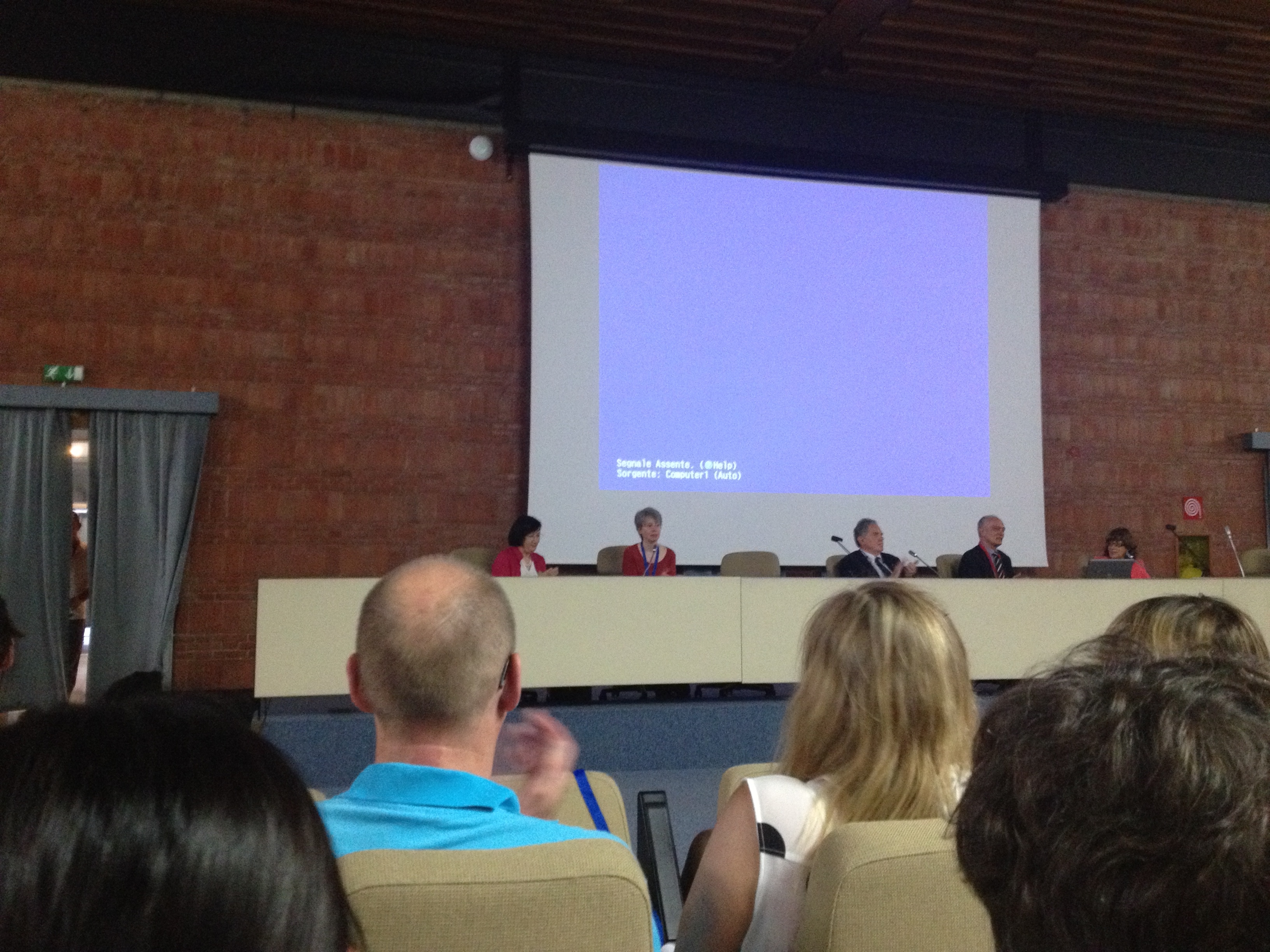
At last, I’m sitting in the lecture theatre of the Biblioteca Nazionale Centrale in Rome in the opening ceremony of EAHIL 2014. Browsing some of the posters as they were being put up in the foyer already brought me some new insights that I’ll have to build into my own work from now on. I really look forward to the all the things I’ll learn in the next three days!

A source of endless frustration: e-books

It seemed so simple: instead of shifting piles of printed books every day, libraries would license core textbooks on-line, and students would read them on their own devices. No more queues for core texts during exam preparation, no more anatomy atlasses hidden inbetween Geology, no need any longer to preserve copies of the past edition for the busiest times of year.

But in real life, e-books turned out a nightmare. Why does one e-book from publisher X open on the iPad, while another one doesn’t? Does the viewer which e-books from a certain set from publisher Y require, allow printing chapters? Why is there  no viewer for that publishers’ titles for Android? There’s a ‘Download’ button showing which doesn’t do a thing – what’s that good for? How do I get this e-book into Colwiz, for sharing notes with my revision group? Are you sure that’s not possible at all? I’ve got these anatomical images on my tablet now, but isn’t it daft they aren’t three-dimensional?

Especially since iPads have made their entry, students would be prepared to try even core textbooks in the on-line format. But at the same time, students are IT-savvy enough not to put up with all the limitations publishers impose on their content. And this includes not just all the DRM hurdles, but also the limited functionality: students expect e-books to make good use of the capabilities of their tables, from advanced handling of images (zooming, turning by 360º…) to sharing annotations in the cloud. And they certainly won’t put up with e-books that can only be viewed in a special reader, one page at a time…

Overall, e-books have, so far, been a pretty disappointing experience for our readers. It is about time we listen to their frustration, and make it plain to publishers what we expect in return for a share of our budget. We’ve done it with Thieme – they now accept that their former e-book format (which required Flash, i.e. wouldn’t open on the iPad) was a mistake; and, at long last, Thieme e-Books are now available in a Flash-free format.  Let’s make sure other publishers, too, begin to take our readers’ needs more seriously!